
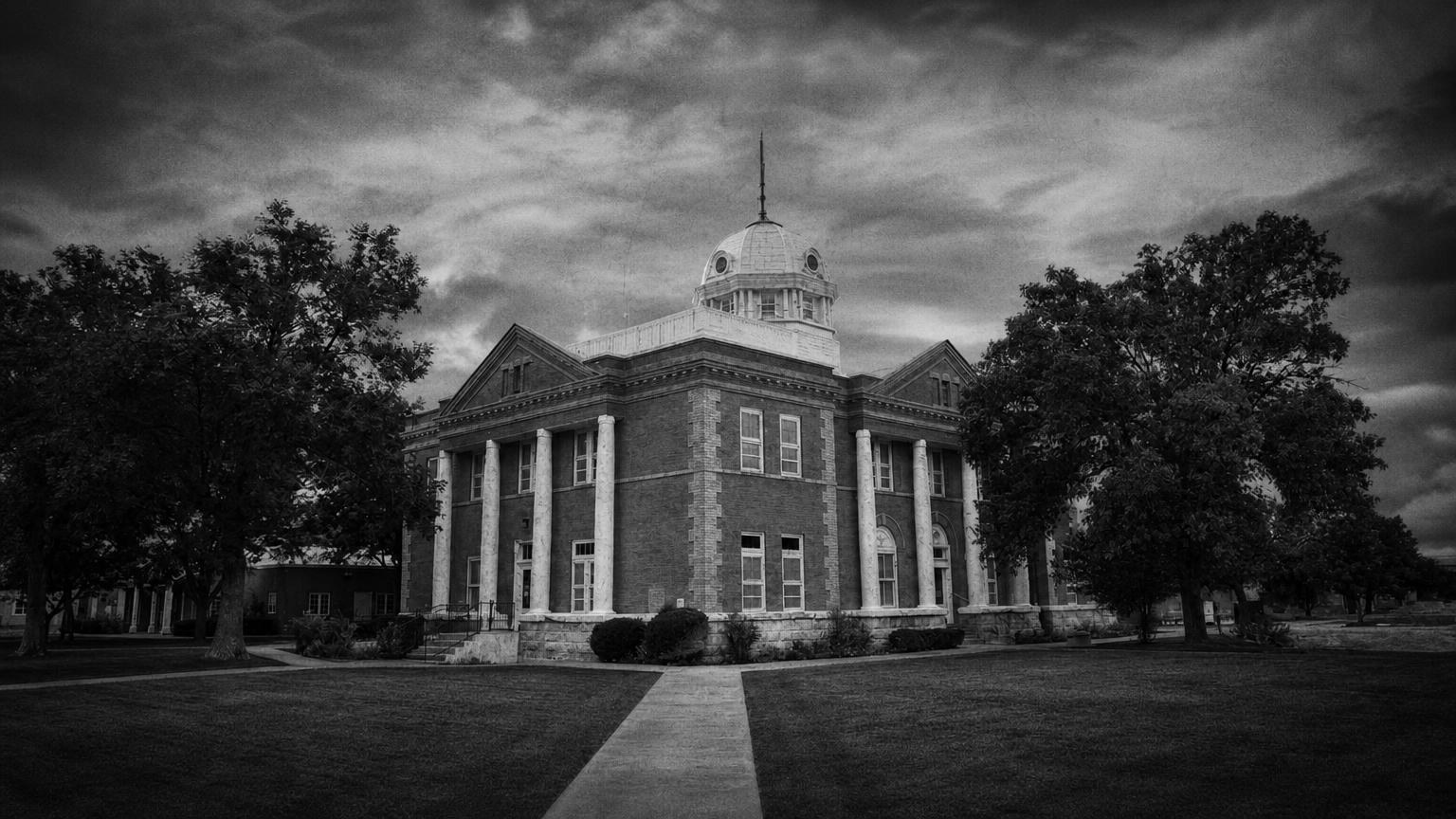
The judge in Union County Courthouse's haunting story has no established name. The building does: the historic courthouse in Clayton, New Mexico, with a documented construction history and a place in the state's judicial record. Between that identifiable courthouse and the unnamed courtroom figure lies the central gap in the legend.
The earlier account supplied voices, cold spots and a lingering judge. The cited material establishes the setting more securely than it establishes any of those encounters.
Clayton's Courthouse, Built in 1909
The New Mexico Judiciary's 2012 annual report identifies the courthouse as a 1909 design by D. P. Kaufman & Son. Those details anchor the article to a particular building and provide a concrete starting point for its history.
An architect's name and a construction date answer questions about the courthouse's origins. They do not authenticate a figure reportedly seen inside it. The historical setting can be documented even when the haunting narrative remains difficult to trace.
A Distinction Recorded in 2012
The annual report described the building at that time as New Mexico's oldest county courthouse in continuous use. The date belongs with the distinction: a statement published in 2012 should not quietly become a newly verified ranking.
Continuous use is meaningful as a historical description of the building's civic role. It should not be stretched into a claim about present conditions beyond the reviewed material, or treated as evidence that a former occupant has somehow remained there after death.
Finding the Right Union County
Numerous counties share the Union name. A courthouse photograph or ghost story lacking a reference to Clayton or New Mexico may concern an entirely different location.
That identification problem comes before any interpretation of an alleged encounter. Readers need to know that an account belongs to this courthouse before using it to develop this building's story. A shared county name cannot connect an otherwise unplaced courtroom apparition to Clayton.
The Judge Who Arrives Without a Name
The earlier account mentioned a former judge appearing in a courtroom, along with voices and cold spots in a basement. It supplied no judge's name, witness interview, date or case record connecting a death to those reports.
The courtroom figure can be described as part of the folklore, but identifying it as a particular historical person would add an unsupported claim. Even the label “judge” belongs to the narrative's interpretation unless an attributable account explains what was observed and why that identity was assigned.
Voices Beneath the Courtroom Story
The alleged basement voices and cold spots have the same missing foundation: no attributable description of their circumstances is supplied. The material does not establish what caused them, or provide enough detail to test a specific ordinary explanation.
A dated local newspaper account or an attributable witness description specifying the room and circumstances would be a useful starting point. Architectural history establishes what a building is; it cannot determine the source of an unusual sound inside it. A historical record and an encounter report answer different questions, even when they concern the same address.
Keeping Clayton's Stories in Their Own Rooms
Clayton also appears in the Herzstein Museum's history. Reading the two locations together can help distinguish town history from stories assigned to individual buildings. Their shared setting does not make the evidence for one interchangeable with the evidence for the other.
Neither a historic designation nor an online haunting label grants permission to enter restricted spaces. For this courthouse, the strongest surviving outline is still the documented building in Clayton. The unnamed judge remains within the archive's folklore, waiting for an account that supplies more than a role and a room.
What would you want to learn about Clayton’s unnamed courtroom figure before assigning it to someone in the courthouse’s history?