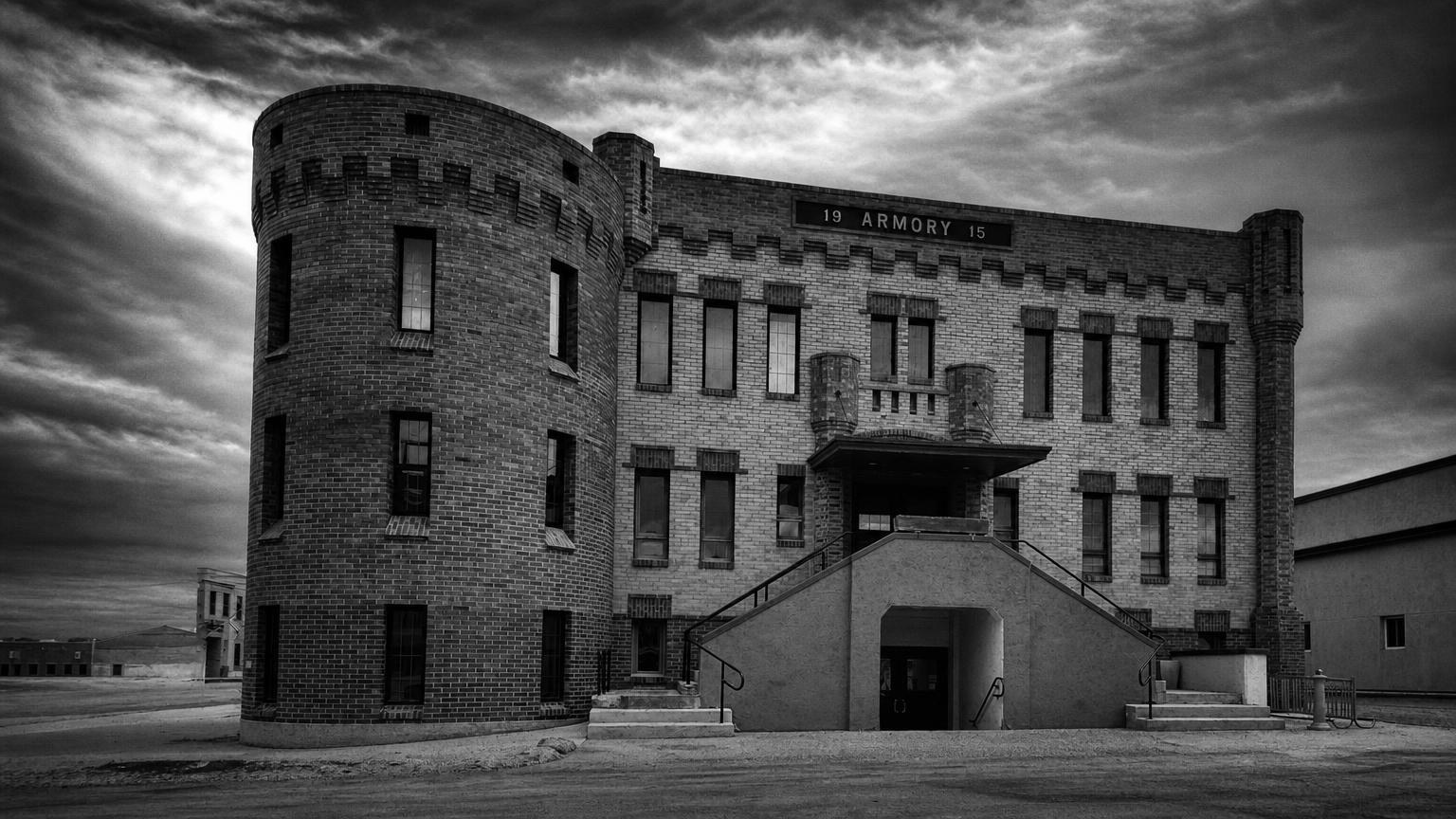
A corner turret gives Williston's Old Armory the look of a place built to stand guard. Its documented past, however, includes homecoming celebrations, dances and roller skating alongside National Guard activity. The shadowy soldier of its ghost stories occupies a less certain place in that history: a reported figure without an identifiable witness in the available account.
A Fortress Shape for a Shared Building
The Old Armory in Williston, North Dakota, was planned during 1915–1916 as a military and community building. Its National Register nomination describes support from the Guard, city, state and local citizens.
Architect Robert Stacy Judd gave the brick structure a prominent corner turret and other fortress-like details. Those features conveyed strength and security. They do not establish a battlefield past, and the building's military appearance should not be allowed to supply events absent from its documented history.
Training Shared Space With Entertainment
The project was intended to accommodate training as well as meetings, conventions and entertainment. Its public purpose was therefore part of the plan, rather than an incidental footnote to a purely military building.
That combination matters when imagining the rooms. An account focused only on soldiers can make every unexplained sound seem to belong to military service. The documented uses provide a broader context, one in which civic gatherings and recreation deserve as much attention as the Guard.
A Homecoming Before the Later Dances
The nomination identifies a two-day homecoming for returning First World War soldiers as the armory's first public event. Later uses included dances, roller skating and community recreation.
These are specific parts of the building's story, with a documentary source behind them. They also complicate an exclusively ominous reading of the place. The armory's history includes people coming together for celebration and entertainment; it cannot be reduced to an image of soldiers waiting for combat.
The Soldier in the Archive's Shadows
The haunting stories describe footsteps, cold spots and a shadowy soldier. No named witness, dated investigation or accessible original recording accompanied those claims in the earlier account.
That makes a soldier legend the appropriate description, rather than an assertion that guardsmen still patrol the halls. Even clothing attributed to a fleeting figure would not establish a person's identity or military unit. The supernatural interpretation extends beyond what the available account allows readers to check.
Listening for Context in an Auditorium
A stronger encounter report would identify the room, time, people present and recording conditions. Those details would make it possible to examine the observation before deciding what it might mean.
Sound traveling through an auditorium, ordinary drafts and incomplete views are possibilities to consider, not explanations demonstrated for a particular incident here. Missing documentation does not tell us what someone experienced. It limits how confidently an experience can be reconstructed and how far a claim about its cause can go.
The Armory Beyond Its Watchful Turret
The turret provides a striking frame for a ghost story, but the documentary record gives the building a fuller character: shared investment, military training and public recreation. Keeping those histories visible prevents an unverified soldier figure from becoming the armory's only remembered occupant.
Continue through North Dakota's archive or compare another civic landmark, Alton Town Hall. Williston's Old Armory leaves a question about its reported shadows, while its role as a gathering place rests on firmer ground.
How might Williston’s dances, celebrations and roller skating change the story suggested by the armory’s watchful turret?