
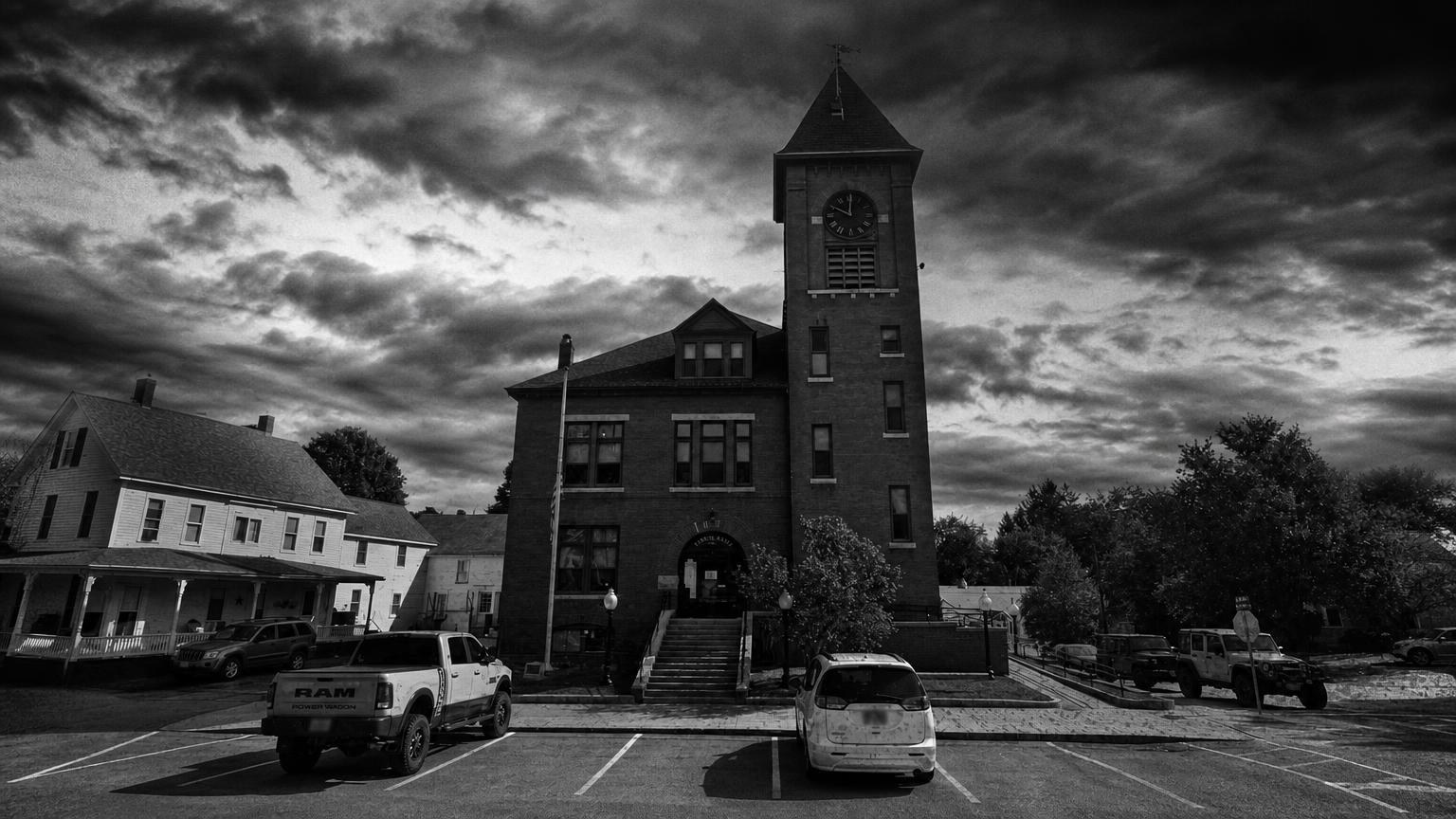
Alton Town Hall has exactly the kind of layered public history that attracts ghost stories. The 1894 brick building has held municipal offices, emergency services, a jail cell, a bank, a library and a performance space. That gives the building a long human history. It does not, by itself, identify the footsteps, whispers or figures later attached to its paranormal reputation.
The Clock Tower Over Alton's Public Life
The Town of Alton's history dates the building to 1894 and describes an eighty-five-foot tower with a four-sided clock and a former fire whistle. The structure was meant to be seen and used. It sat at the center of civic life rather than on its margins.
That is an important starting point because old public buildings accumulate memories for ordinary reasons. Generations of residents pass through them, work in them and associate personal events with the rooms inside. A haunted reputation can grow on top of that history without replacing it.
A Jail Cell, a Fire Whistle and an Auditorium
The lower level once served police and fire functions, and a jail cell occupied the basement. Other parts of the building were used as a bank and library. The auditorium hosted plays, films, dances and graduation ceremonies.
Those details make the building more interesting than a generic story about an old town hall. They also create plenty of opportunities for later legends to attach themselves to specific rooms. A former jail cell, for example, can feel ominous to a visitor who knows what it was used for. That feeling is not evidence that someone died there or remains there as a spirit.
Footsteps, Whispers and Figures Near the Stairs
Paranormal retellings associated with Alton Town Hall describe footsteps, whispers, cold spots and figures near stairways. The earlier account also included stories about a deceased official and a young woman, but it did not provide witness names, dates, recordings or archival records for those biographies.
Those details should stay out of the building's documented history unless evidence surfaces. Saying that visitors or storytellers have described a figure is different from assigning that figure a name, life story and cause of death.
Why an Unnamed Spirit Should Stay Unnamed
Ghost stories often become more detailed as they are repeated. A vague figure becomes a former employee; a sound becomes the footsteps of a prisoner; an uneasy feeling gains a tragic explanation. Each added detail makes the story feel more complete, but it also creates another factual claim that should have a source.
At Alton Town Hall, the safer line is also the clearer one: unusual experiences have been described, while the identities attached to them are not established by the historical sources reviewed here.
Old Buildings Create Atmosphere, Not Proof
A clock tower, basement cell, auditorium and more than a century of public use give the town hall a strong sense of place. They can also affect how people interpret sounds, shadows and temperature changes. Large rooms echo. Stairwells carry noise. Mechanical systems change over time. Expectations matter too.
None of those possibilities proves that every report has an ordinary explanation. They are reasons not to skip directly from an unexplained experience to a paranormal conclusion.
What Would Move the Story Forward?
A stronger case would include dated witness testimony, the exact room involved, environmental conditions and any original audio, video or photograph preserved with context. Repeated reports from independent witnesses describing the same specific event would be more useful than a legend repeated without a source.
Until then, Alton Town Hall's strongest verified story remains its long role in civic and cultural life, with a paranormal reputation that stays intriguing precisely because its claims are not settled.
Continue with New Hampshire stories or compare the distinctions between history and reported activity at Norwich University.
Which of Alton Town Hall’s many civic uses might help place a stairway encounter in its proper historical setting?