
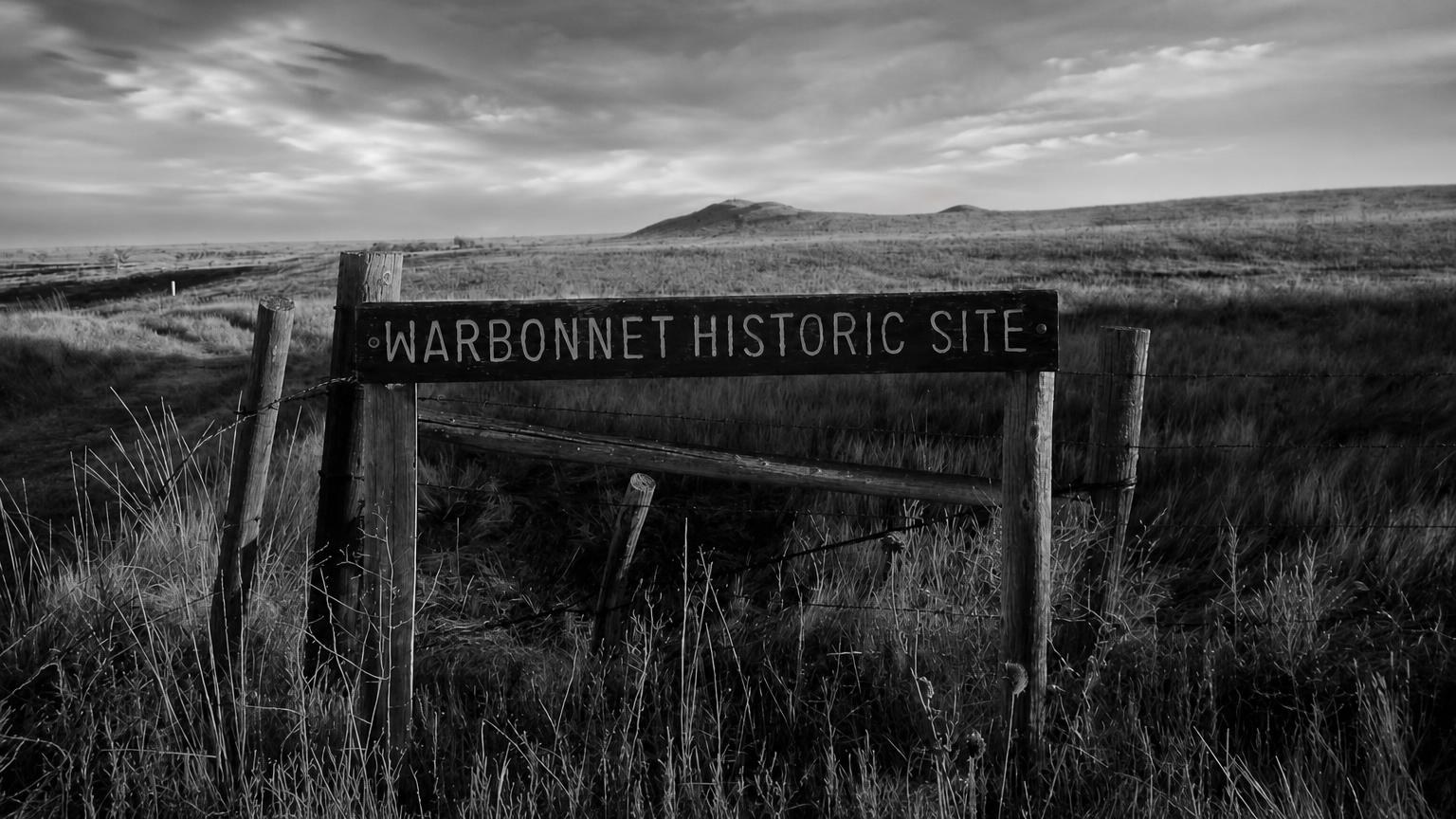
The riders in Warbonnet Creek's ghost stories belong to a different record from the cavalry and Cheyenne people who met there in 1876. Separating them reveals a story already charged with violence, fame and disputed retelling—without turning the Nebraska grassland into evidence of a supernatural encounter.
A Crossing in Present-Day Sioux County
The Nebraska State Historical Society's account places the July 17, 1876, confrontation at a supply-trail crossing in present-day Sioux County, in northwestern Nebraska. It involved the Fifth U.S. Cavalry and Cheyenne people.
The account describes a brief skirmish, not a prolonged battle with large numbers of dead. That scale is essential to responsible storytelling. Expanding the encounter or its casualties to make later haunting claims more dramatic would change the history on which the article depends.
Yellow Hair, Wesley Merritt and William F. Cody
The historical account identifies Wesley Merritt as the cavalry commander and describes scout William F. Cody's killing of the Cheyenne warrior Yellow Hair. It also discusses later disputes over who killed Yellow Hair.
Those points should be read together. Reporting what the account describes does not require erasing the disputes it also records. Nor should a later ghost narrative be used to settle them. The named people belong to the historical discussion, and no evidence supplied here connects any of them to a reported apparition.
A Brief Encounter With a Larger Afterlife
Warbonnet Creek also became part of Cody's fame, a connection discussed in the historical account. That gives the event another layer: what happened at the crossing and how the encounter was subsequently remembered are related but distinct subjects.
Historical interpretation needs to identify whose account is being used and how later commemoration shaped the story. A dramatic retelling can direct attention toward certain figures while leaving readers with an exaggerated sense of an event's scale. Keeping the description anchored to a brief skirmish prevents that shift from becoming an unexamined fact.
Spectral Riders Without a Traceable Report
An earlier account described horseback apparitions, cries and unexplained cold spots. It supplied no named witnesses, dates or recordings for those specific claims, and none of the cited sources substantiates them.
These details therefore belong to unverified haunting lore. They cannot be treated as a series of documented witness encounters, much less as a continuation of the 1876 confrontation. Even the image of a spectral rider supplies no reliable identity. Connecting one to a historical participant would add a claim the evidence does not support.
What a Solemn Landscape Does Not Tell Us
A visitor may respond strongly to a place associated with conflict. That response can be meaningful as personal experience without identifying the presence of a dead person's spirit. Emotion and historical awareness are not, by themselves, measurements of paranormal activity.
The same care applies to cultural attribution. These ghost stories should not be presented as Cheyenne belief without an attributable source. Nothing in the supplied material establishes what Cheyenne communities believe about the site. Leaving that question open is more accurate than giving an unsupported legend the authority of an Indigenous tradition.
Reading the Marker Without Enlarging the Battle
Photographs of open grassland or a historic marker show the place in the present; they do not depict the 1876 encounter. Access should follow actual posted arrangements, rather than assumptions drawn from a haunting article.
Compare Antietam's battlefield history for another setting where recorded losses and later supernatural claims require different sources. At Warbonnet Creek, the task is particularly specific: keep the brief skirmish, Yellow Hair's death, Cody's fame and the unsupported riders visible as distinct parts of the story.
How might comparing Cody’s public retellings with the brief Warbonnet Creek skirmish change the way you read the later rider stories?